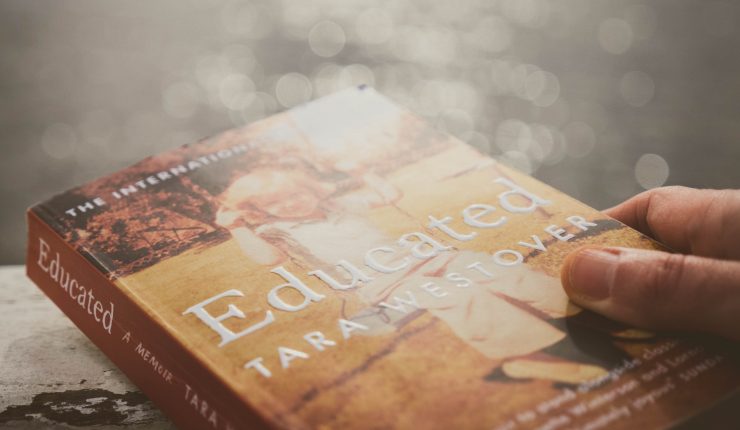
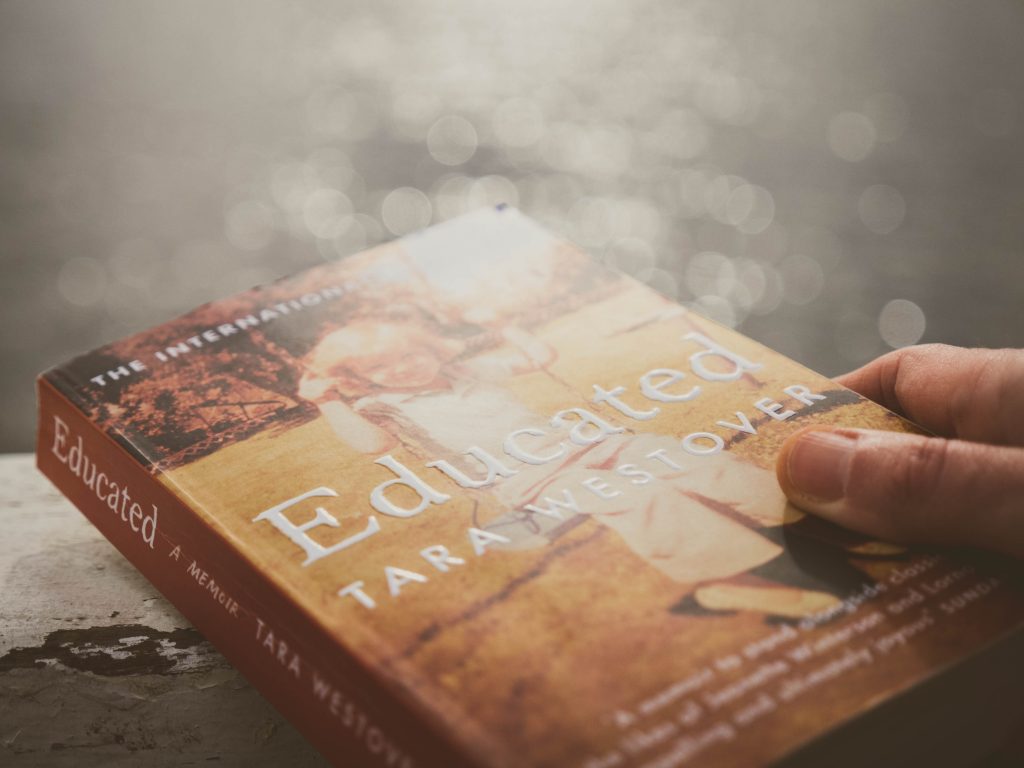
Educated (2018) by Tara Westover is undoubtedly a noteworthy tribute to the enlightening experience we generally refer to as “education.” For me, however, this bestselling novel is an homage paid to something even more important – to independent, critical thinking. Ultimately, education is external and optional, whereas reasoning comes from within and can easily become obscured by schooling. The author and the protagonist of this memoir, Tara Westover, is surely blessed with the ability to think for herself.
Born as the seventh child at home in the middle of nowhere, Tara is brought up devoid of birth certificate and with a sentence to home-schooling. She is raised in a household dismissing anything to do with the national government, even public education or health care. Her closest family and the surrounding Mormon community shape her horizons: an outlook devoid of a slightest view of the world beyond her father’s farm and junkyard situated at the base of an Idaho mountain. In other words, Tara is raised in a hard to imagine isolation.
Based on a personal journal, Educated describes the author’s gradual process of moving away from home – a process not only physical, but above all mental and emotional. Already at eleven, she begins to see her familial household as being destructive and unsafe. She feels a need to release herself from the toxic environment: tyrannical and bipolar father, as well as her abusive brother Shawn who humiliates and physically hurts her. Not yet a teenager, she finds herself a job at a local grocery store and attends music and theatre classes. The latter enable her for the first time to experience a sense of belonging and discover self-expression. At such early stage of life, Tara is drawn to the only person in her surroundings, who, she feels, can help her on her path to liberation. She seeks the attention of her older brother Tyler, who, through books, learning and music, reveals to her a snippet of the wider world. It’s Tyler who quietly convinces Tara to apply to college. Somewhere at gut level his younger sister understands that education is the only way out and so she does everything that’s in her power to attend university (despite the lack of high school diploma!). But, it’s in school among a diverse community that our protagonist starts facing an even more intense inner conflict.
Sudden exposure to a blend of people and ideas gives her dizziness. She becomes torn between her father’s life philosophy – steeped in religious zealousness and anti-federal stance – and new points of view. At college she experiences a strong sense of not belonging. Finally, the constant split gives Tara stomach ulcers and forces her to see a doctor and take medication (a resolution that would never be agreed to by her parents). At the same time, her intuition again prompts her to get in touch with the right people: the university bishop, who convinces her to apply for a government grant to pay for a costly dentist visit, and the Jewish history professor, who encourages her to take part in a study abroad program at Cambridge University, England. Again, both such initiatives would be unthought-of in the eyes of her family. The Jewish history professor’s incentive allows Tara to even become a full-time student at Cambridge, where she is termed “pure-gold scholar” by another mentor. While studying in England, Tara continues visiting Idaho regularly, but becomes more and more detached from her closed-off family. Yet, the moment her parents claim she’s controlled by the devil, Tara falls into a severe depression and experiences panic attacks. Finally, she receives help from the university counselling services and seeks solace and relief in education.
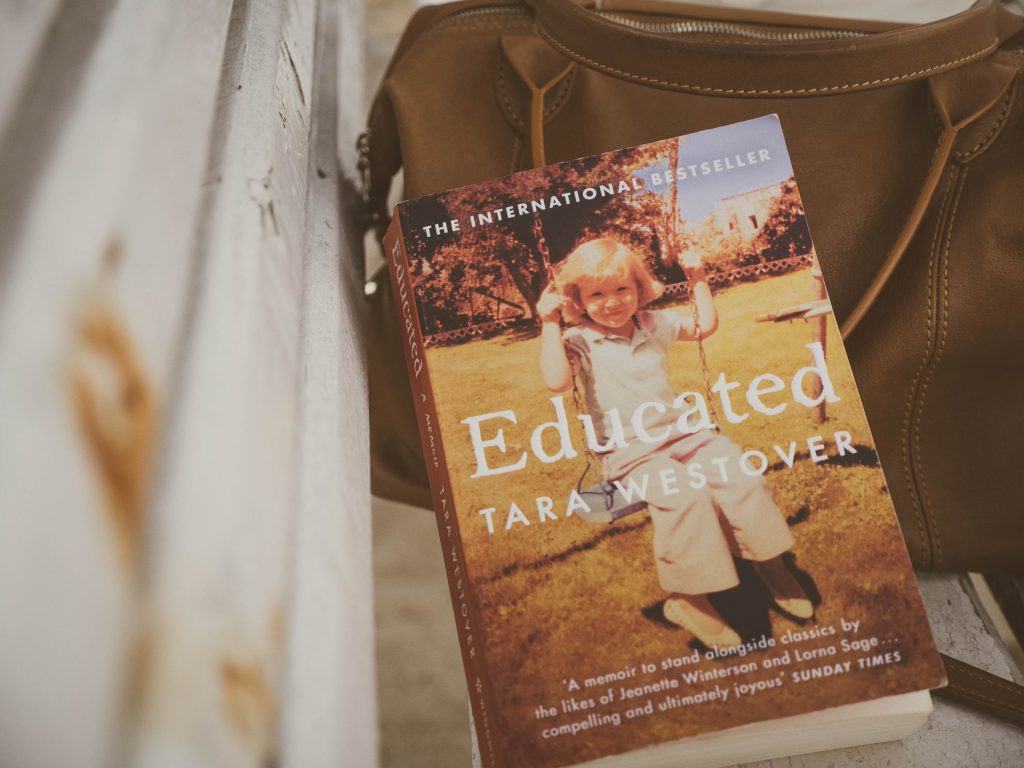
However, what is important to ask oneself while reading the book, is how does Tara Westover understand “education,” and why she entitles her book Educated. For the author, education stands as a synonym to independent, critical and free thinking; something far from being a package of facts and pieces of knowledge. When teenage Tara secretly studies for a math exam mandatory for entering college, we can already notice her reasoning is far from conventional. Tara sees such concepts as fractions, decimals, reciprocals, trigonometry and so on, as a reflection of the wider universal order. She does not merely understand mathematics as a set of problems to solve, but as a key to explain and predict reality. To this young girl math serves as a gateway to a world of law and reason, a world she longs for in the chaotic and volatile house led by her religiously fervent father.
At college, Tara is like a blank slate. Her educational deficiencies become evident. She asks out loud what “Holocaust” is, does not understand the term “essay,” or doesn’t know how to study for an art history exam, being unaware that an art history textbook should be read rather than merely looked at! At home, she sees Tyler reading Les Miserables. Gathering it’s a novel she should read, she buys her own copy, but has a hard time distinguishing between facts and fiction: “Napoleon felt no more real to me than Jean Valjean. I had never heard of either,” she admits in the memoir. Her professors, however, don’t score her out. Rather, they notice that despite this student’s gross shortages, she’s naturally intelligent, thinks deeply and is eager to learn. Her bright intellect must shine through, if she finally paves her way to Cambridge University and then Harvard – institutions not interested in students who treat education merely instrumentally.
Hence, for me, this book is fore and foremost about the real meaning of education, the meaning frequently ignored. The novel reminds us that learning is not only about acquiring a set of knowledge or holding diplomas in the hollow of one’s hand. Rather, it is a long and turbulent process, not avoid of doubt and undergoing changes. It should be seen as a long path directed towards finding one’s own voice and living in one’s own mind. Tara’s story illustrates how true education can lead to liberation, in her case, liberation from her old self. Gradually, she comes to understand that she can make her own decisions, not dictated by her God-fearing father; that she can accept medical help or help from the government; or that she can study “unwomanly” subjects, like psychology or politics. Through worthwhile schooling, Tara finds the power to create herself anew, independently from where she comes from. Educated makes but a point: life is not a thing unalterable, each one of us is the author of his own history.
I admire Tara Westover’s Educated for being a vivid and honest memoir. It’s a candid description of one’s transformative process, a book giving hope and proving that change is possible. In my opinion, Educated could serve as a great set book for high school students and a good read for teachers who believe in the value and power of their profession. I look forward to a release of a movie based on Tara Westover’s poignant and evocative life story.