
This summer I have again immersed myself in literature. To be exact, in Modernist Polish literature. I have been reading it for sentimental reasons and to refresh and look anew at some of the books I had once covered in school. The process of restoring these novels has been fascinating, but suddenly books of the past began soaking me in, too deep, too far from today. And then, a friend popped up and gave me a helping hand. She proposed I read something miles apart – a contemporary British novel by Deborah Levy entitled Swimming Home (2011).

As it has again turned out, it’s always a good idea to take a break. Reading a current literary piece made me look at Modernist literature from perspective and realize how different writing had been a hundred years ago. Especially, in terms of style. After reading a couple of classics, Swimming Home seemed like confronting a brain teaser, like doing jigsaw puzzles or a riddle. Today, it turns out, there does not have to be clear chronology, paragraphs leading straight on to the following paragraphs, or “main” versus “secondary” protagonists etc. In Swimming Home we do not as much experience the heroes’ internal dialogues, but explore their subconscious, their irrational, imagined, dreamy. What seems to be the backdrop, is what in a book of today defines reality. Major themes explored by Levy in her book – such as depression, divorce or lack of clear division between social classes – have nowadays become common, almost persistent, and are therefore seen and portrayed in new and adequate ways.
Reading Swimming Home was to me like viewing a theatre play. All the way through I saw the action of the book being performed on stage. The podium was immersed in an unique, somnolent ambience of the Côte d’Azur: a dazzling mise-en-scène with pine trees, cypresses, the Promenade des Anglais, the Nicean Negresco Hotel, a villa and swimming pool… (This impression of mine is not inapt, taking into consideration Levy’s playwriting origins.) The story portrays a week-long vacation in the South of France of two privileged British couples, and begins the moment they discover a beautiful young woman swimming in their rocky pool. Of course, her presence disturbs the vacationers’ established order and leads to disorienting vicissitudes and an unexpected ending. As the surface of the book seems tranquil, lavish, bright and glistening, its undergrowth is dark, murky and sinister, just like the natural pool. Swimming Home is a psychological mystery keeping the reader in suspense until the very end.
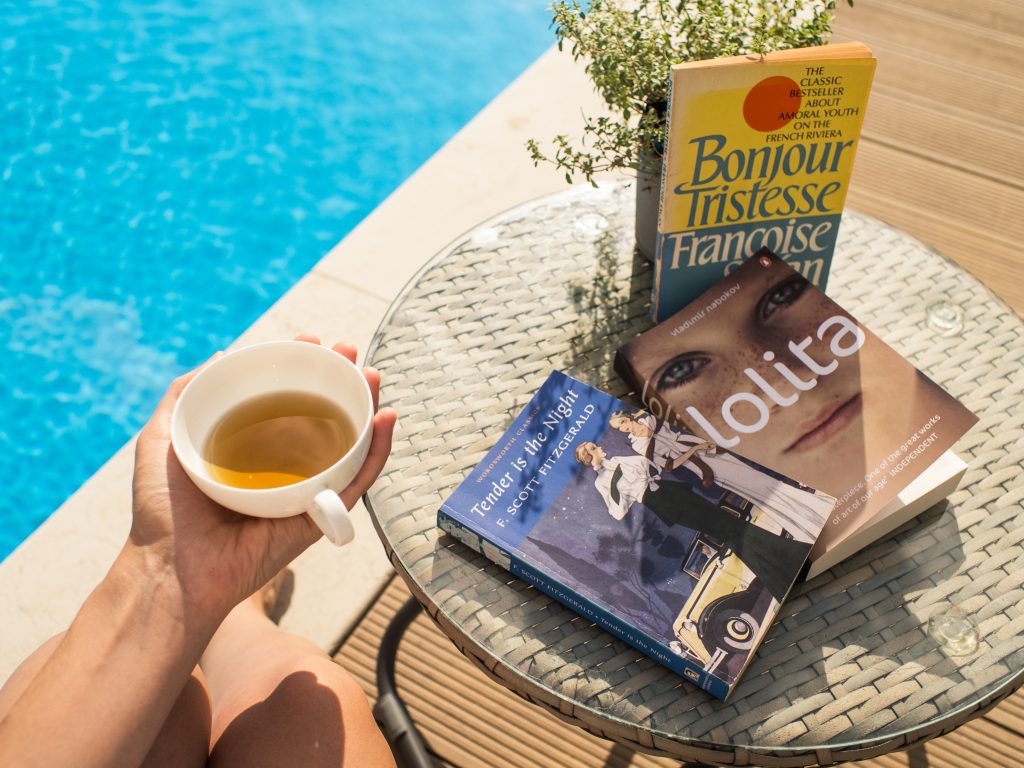
Apart from imagining an actual theater drama, I made other deeply felt connotations. Being absorbed in Swimming Home has led me to reenter some of the greatest books in history. While reading Levy’s novel, I again pulled out from my bookshelf Fitzgerald’s Tender is the Night, Françoise Sagan’s Bonjour Tristesse or even Nabokov’s Lolita. This is how in 1955 young Sagan – an innate literary talent – describes in Bonjour Tristesse her vacation at the Côte d’Azur: “(My father) had rented a large white villa on the Mediterranean, for which we had been longing since the spring. It was remote and beautiful, standing on a headland jutting over the sea, hidden from the road by pine woods. A goat path led down to a small, sunny cove where the sea lapped against rust-colored rocks.”
I think I could group together the above mentioned titles for their superb ability to portray imperceptible, elusive atmosphere. In these books, there is not much action, yet they are able to evoke and stir in us the deepest, often ambivalent, emotions. I could also term them “elegant literature.” These novels are all chicly, impeccably dressed in words, just like the famous introduction to Lolita: “Lolita, light of my fire, fire of my loins. My sin, my soul. Lo-lee-ta: the tip of the tongue taking a trip of three steps down the palate to tap, at three, on the teeth. Lo. Lee. Ta.” They are like the Côte d’Azur itself, an attractive, magical and lavish place, where looks and appearances do matter and make up the show.
Even though reading Levy’s Swimming Home did me good, and it has stretched my literary horizons, I do not find this novel to be a new classic. As I was reading it, I could not help thinking that this Man Booker Prize awarded title is in fact more of a stylistic experiment than a literary wonder. I have a feeling as if the essence (some call it: truth) that we as readers long for in literature, and are able to find only in few books, has been left out in favor of stylistic décor. And, indeed, Levy excellently handles such techniques as repetition, irony, sarcasm, the absurd, the nonliteral, or the underlying of details and objects seemingly marginal. However, at the end, we just don’t learn enough about the characters and the motifs behind their behavior. The book’s writing style is very well accomplished, but style is simply not enough.
Today’s grand concerns touched upon by Levy in Swimming Home – depression, breaking up of family, the everything-goes medley of social classes – have also been treated too superficially. Through the novel we realize their notoriety, but we just don’t get at the roots of why so many “normal” people experience depression, why family members become icily isolated from one another, or why today’s social order can seem so confusing.
When reading the novel, I felt as if I were at an amusing dinner party during which its quaint participants communicated only on surface level, mainly through laughter or short truncated dialogues. The party was much fun, not without an admixture of marijuana, but it did not give the opportunity to really get to know the partakers. So, if that is what we want from literature – an entertaining, sophisticated, eccentric party, even bizarre at times, then this is what we get.